Precision-engineered for laboratories, training institutes & tender supply — manufactured in India.
Response within 1 business day · Global logistics · Tender-ready docs
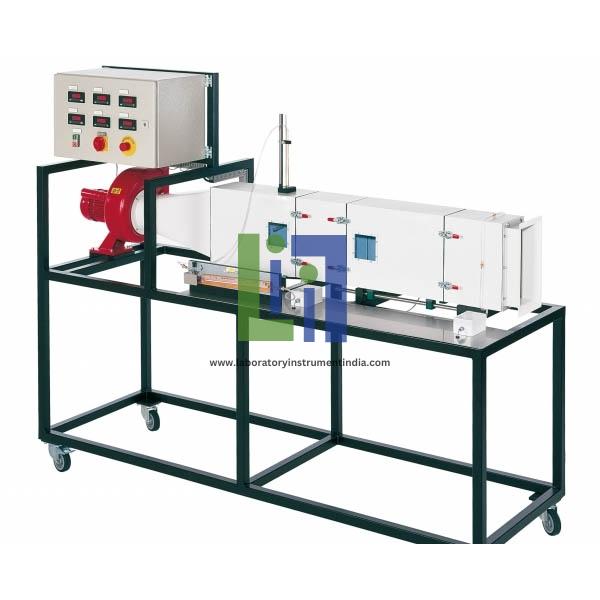
The plate has two different surfaces so as to study the effect of surface conditions on the boundary layer. Side bodies can be used in the measuring section. The experimental unit used in the aerodynamics trainer allows the boundary layer on a flat plate to be studied. Thus the boundary layer phenomena can experience interference with a degressive or progressive pressure curve and, for example equalise the friction loss of the flow. For this purpose, air flows along the plate, parallel to the surface.
Learning Objectives And Experiments:
Boundary layer interference with
Degressive/progressive pressure curve
Internal friction of gases
Influence of surface roughness on the formation of a boundary layer
Investigation of the boundary layer on the flat plate.
Investigation of boundary layers on a flat plate with flow along the plate
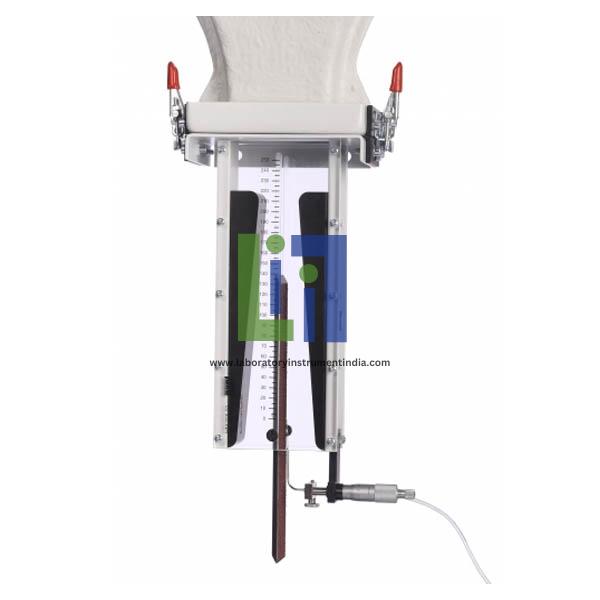
Adjustment of the Pitot tube to the plate using micrometer screw
Pitot tube for measuring the total pressure at the plate
Removable side bodies for interference of the boundary layer with degressive or progressive pressure profile
Accessories for the aerodynamics trainer
Plate with two different rough surfaces
Moveable plate, along the direction of flow
16 tube manometers for displaying the dynamic pressures.
Request a custom quote, full technical datasheet, or place a bulk / tender enquiry. Our specialists will get back to you within 1 business day with pricing, lead time, and export documentation.

As one of India's leading Boundary Layers manufacturers, suppliers & exporters, we deliver tender-grade quality with documented compliance to institutions, laboratories & training facilities across 65+ countries.
Every Boundary Layers unit is manufactured to international quality standards and tested before dispatch. Full QC documentation & calibration certificates included.
Established export channels across Africa, Asia, the Middle East & beyond. Complete shipping documentation — certificates of origin, packing lists, test certificates, customs paperwork.
Need a specific configuration of Boundary Layers? We offer customisation for tender specifications, OEM branding, voltage variants & bulk institutional orders.
Technical consultation before purchase, installation guidance, operator training documentation, and responsive after-sales support — backed by our specialist engineering team.
Trusted by institutions, governments & industries worldwide for reliable, tender-documentation-ready supply.
We supply Boundary Layers across seven major buyer segments worldwide:
Practical laboratory training & coursework experiments
STEM education & physics / chemistry / biology demos
Process quality, testing & calibration requirements
Clinical lab, diagnostics & pathology applications
Ministry, defence research & PSU lab infrastructure
UNICEF, WHO, UNDP & bilateral aid procurement
Skill development & technical training labs
Direct & sub-contractor tender fulfilment
Manufacturing scale & global reach
Documentation-ready supply for tender-grade procurement — certificates of origin, test certificates, calibration data & compliance matrices.
Laboratory Instrument India is a recognised manufacturer, supplier and exporter of Boundary Layers from India. We supply this product across our complete export network — from individual institutional purchases to large-scale tender supply contracts.
Nigeria, Kenya, Ghana, Ethiopia, Tanzania, Uganda, South Africa, Egypt, Morocco, Algeria, Senegal, Cameroon
Bangladesh, Sri Lanka, Nepal, Myanmar, Vietnam, Indonesia, Philippines, Malaysia
UAE, Saudi Arabia, Oman, Qatar, Kuwait, Iraq, Jordan
All shipments include complete export documentation, customs paperwork & freight handling.
Common questions from buyers, procurement officers & technical evaluators about ordering, customisation, lead time & documentation.
Speak directly with a product specialist for technical clarifications, custom configurations & bulk tender pricing.